
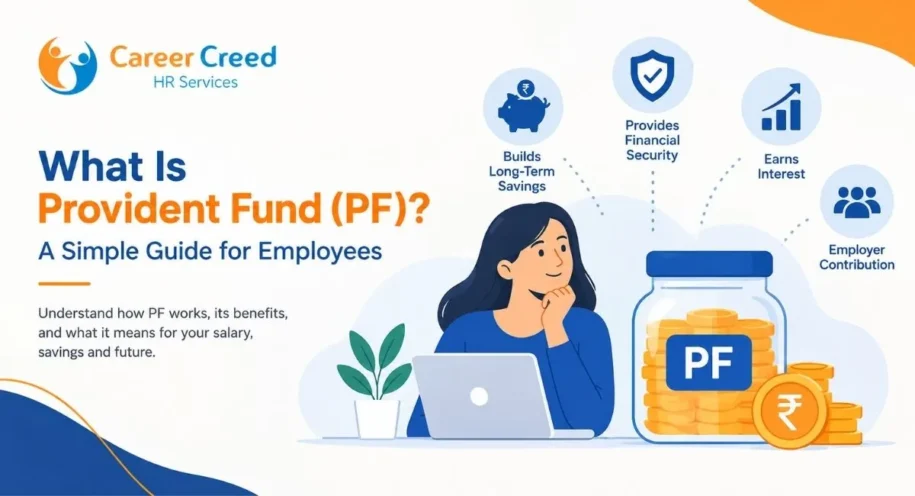
Provident fund (PF) is a common part of salary and employee benefits in India. It helps employees build long-term savings during their working years. Every month, a part of the employee’s salary is contributed to the PF account, along with an employer contribution. Over time, these regular contributions can create a useful financial cushion for the future.
If you have ever looked at your salary slip and wondered what is PF, why money is deducted from your salary, or how the employer contributes to it, this guide explains it in simple terms.
What Is Provident Fund?
A provident fund is a retirement savings system where both the employee and employer contribute a certain amount every month, subject to the applicable rules.
In India, the Employees’ Provident Fund (EPF) is managed by the Employees’ Provident Fund Organisation (EPFO). The scheme is designed to encourage employees to save regularly while also providing certain benefits connected with retirement and other permitted situations.
For employees, PF is not simply a deduction from salary. It is a structured savings benefit where contributions accumulate in an account in the employee’s name.
What Is a Provident Fund in Salary?
When people ask what provident fund in salary means, they are asking how it shows up in their pay structure.
Your salary usually has parts like basic pay, HRA, allowances, and so on. PF is calculated on your basic salary plus dearness allowance (DA). Here is the usual break-up:
- Employee share: 12% of basic + DA is deducted from your salary.
- Employer share: Your employer also pays 12% of basic + DA.
The employer’s 12% is split into two parts. About 8.33% goes to the Employees’ Pension Scheme (EPS), and the remaining 3.67% goes to your PF account. The pension part is calculated on a wage limit of ₹15,000, so it has a monthly cap.
For example, if your basic salary is ₹20,000, your PF deduction is ₹2,400 a month. Your employer puts in a matching amount, so your yearly PF savings grow faster than you would expect. This is why PF appears both as a deduction on your payslip and as part of your CTC.
How Provident Fund Works
Understanding how provident fund works is easy if you follow the money step by step:
- You join a company that is covered under the PF law and get a Universal Account Number (UAN). This number stays with you for life, even if you change jobs.
- Contributions start every month. Your share is cut from your salary, and your employer adds theirs.
- The money is deposited into your PF account through the EPFO portal.
- Interest is added every year. The rate is decided by the government and announced each year. For 2024-25, it was 8.25%.
- When you change jobs, you can transfer your old PF balance to the new account online, so your savings keep growing without a break.
- At retirement or after leaving work, you can withdraw the amount.
The interest is calculated monthly and credited yearly, and it compounds. That means you earn interest on your interest, which makes a big difference over 10 or 20 years.
What Are the Benefits of PF?
There are several benefits of PF for employees. The biggest advantage is that it encourages regular saving without requiring the employee to make a separate investment decision every month.
1. Helps Build Long-Term Savings
A fixed amount is saved regularly from the employee’s eligible wages. Employer contributions also add to the overall benefit, subject to the applicable rules.
Over several years, these regular contributions can grow into a significant amount.
2. Provides Interest on Savings
PF savings earn interest at the rate declared by the government for the relevant financial year. This allows the accumulated balance to grow over time.
3. Employer Also Contributes
One important feature of PF is that the employer also makes a contribution. This makes it different from simply saving a portion of your salary in a personal bank account.
4. Retirement Support
PF is primarily designed to help employees build financial savings for the long term. The accumulated amount can become an important source of financial support after employment, subject to the applicable withdrawal and settlement rules.
5. Certain Withdrawals Are Allowed
PF is generally meant for long-term savings, but withdrawals or advances may be permitted in certain situations under the applicable EPF rules.
The conditions can depend on the reason for withdrawal, the employee’s service period and other requirements. Employees should check the current EPFO rules before making a withdrawal decision.
What About PF When You Change Jobs?
Changing jobs does not necessarily mean that you have to withdraw your PF immediately.
If you move from one employer to another, your PF account can generally continue through the transfer process. Keeping your Universal Account Number (UAN) and employment details properly linked can make managing your PF records easier.
Employees should also make sure that their personal information, bank details and KYC details are correctly updated where required.
Instead of withdrawing PF every time you change jobs, employees should understand the available transfer and settlement options and choose the one that suits their situation.
Is PF the Same as Pension?
PF and pension are related, but they are not exactly the same.
Under the EPFO framework, the employer’s contribution is divided between the Employees’ Provident Fund and the Employees’ Pension Scheme, subject to applicable rules.
The EPF component primarily builds the provident fund balance, while the pension component is connected with pension benefits under EPS.
This distinction is important when reading a salary slip or checking an EPFO statement because the employer contribution may not be credited entirely to the EPF balance.
Who Needs to Manage PF?
For employees, PF may seem like a simple salary deduction. For employers, however, managing PF requires regular attention.
Businesses need to correctly identify applicable employees, calculate contributions, maintain employee records, deposit contributions within the required timelines and handle relevant EPFO processes.
This becomes more difficult as a company grows and the number of employees increases.
Good Payroll management helps businesses keep salary calculations and statutory deductions organised. It can also reduce mistakes in PF calculations and employee salary records.
Similarly, proper compliance management helps businesses keep track of applicable statutory requirements and important filing and payment responsibilities.
Common PF Mistakes Employees Should Avoid
Employees should keep an eye on their PF records instead of assuming everything is automatically correct.
Some common issues include:
- Incorrect personal details in PF records
- Mismatch in UAN or KYC information
- PF contributions not reflecting correctly
- Not checking the employer’s contribution
- Delays in transferring PF after changing jobs
- Assuming PF is calculated on total salary in every case
- Withdrawing PF without understanding the applicable rules
Checking your salary slip and EPFO records periodically can help identify such issues early.
What Should Employees Check on Their Salary Slip?
If you want to understand what about PF in your salary, start with your salary slip.
Look for:
- Basic salary or PF wage
- Employee PF deduction
- Employer PF contribution
- EPS contribution, where applicable
- Net salary after deductions
Your salary structure may also include other components that are not part of the PF calculation base. So, comparing PF only with your gross salary may create confusion.
Final Thoughts
PF is an important part of the employment system in India and can help employees build long-term savings through regular contributions. Understanding what is provident fund, how contributions are calculated and where the money goes can make salary slips much easier to understand.
For employees, checking PF details regularly can help keep their records accurate. For employers, accurate payroll processing and proper statutory compliance are important for managing PF smoothly.
Whether you are an employee trying to understand your salary slip or a growing business managing payroll for a larger team, having a clear understanding of PF can help avoid common mistakes and keep employee records organised.
Leave a Reply