
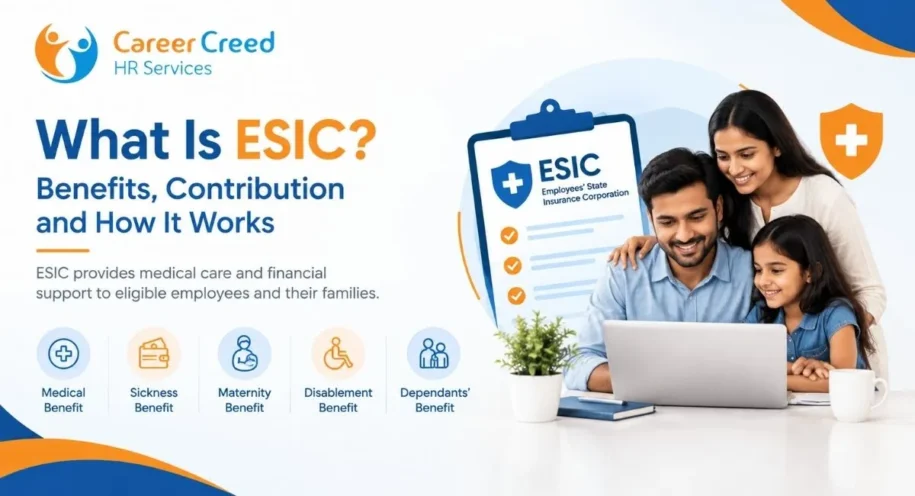
If you are an employee or a business owner, you may have heard the term ESIC while discussing salary, payroll, or employee benefits. But what is ESIC and why is it deducted from an employee’s salary? ESIC stands for Employees’ State Insurance Corporation. It manages the Employees’ State Insurance (ESI) scheme, a social security system that provides medical care and financial support to eligible employees and their families in certain situations.
For many employees, ESIC is simply another line on the salary slip. However, it can provide important support when an employee faces sickness, maternity, disability due to an employment injury, or other covered situations. For employers, correctly handling ESIC is also an important part of regular payroll and statutory compliance.
What Is ESIC?
ESIC is the organisation responsible for administering the Employees’ State Insurance scheme in India. The scheme operates under the Employees’ State Insurance Act, 1948.
The main purpose of ESIC is to provide social security to eligible employees. Instead of an employee having to manage the full financial burden of certain medical or employment-related situations alone, the ESI scheme provides medical and cash benefits subject to the applicable rules and eligibility conditions.
ESIC is therefore not the same as a normal private health insurance policy. It is a statutory social security scheme for employees covered under the ESI Act.
Who Comes Under ESIC?
ESIC coverage depends on factors such as the type of establishment, the area where it operates, the number of employees and the wages of the employee.
According to ESIC’s published information, the ESI Act applies to factories employing 10 or more persons, while coverage has also been extended to various establishments such as shops, hotels, restaurants, educational institutions and other establishments depending on the applicable notification and threshold. ESIC states that the wage ceiling for coverage is ₹21,000 per month, with a higher ceiling of ₹25,000 for persons with disabilities.
This means an employer should not decide ESIC eligibility only by looking at an employee’s salary. The establishment’s coverage and other applicable conditions also need to be checked.
How ESIC Works
So, how ESIC works in practice is quite straightforward.
When an eligible employee works in a covered establishment, contributions are made to the ESI scheme. A part comes from the employee and a larger share comes from the employer.
The current contribution structure is:
| Contribution | Rate |
| Employee’s contribution | 0.75% of wages |
| Employer’s contribution | 3.25% of wages |
| Total | 4% of wages |
These rates have been applicable since 1 July 2019.
The employer generally handles the contribution process, including depositing both shares as required. The employee’s share is recovered from the employee’s wages according to the applicable rules.
For example, if an eligible employee’s wages are ₹18,000 per month, the employee’s contribution at 0.75% would be ₹135, while the employer’s contribution at 3.25% would be ₹585, subject to the applicable rules for calculating wages and contribution.
This is one reason accurate payroll processing is important. A small mistake in employee data, wages or contribution calculations can create problems later.
What Are the Main ESIC Benefits?
One of the most important things to understand about ESIC is that it is not only about medical treatment. The scheme provides different types of benefits to eligible insured persons and, in applicable cases, their dependants.
1. Medical Benefit
Medical care is one of the main benefits under the ESI scheme. Eligible insured persons can receive medical treatment and attendance through the facilities and arrangements provided under the scheme. Medical benefits may also be extended to family members subject to the applicable rules.
This can be particularly useful for employees who may otherwise find regular medical expenses difficult to manage.
2. Sickness Benefit
An eligible insured person may receive sickness benefit when they are unable to work because of sickness, subject to the required conditions and certification.
The benefit is designed to provide some financial support during a period when an employee cannot work because of illness.
3. Maternity Benefit
The ESI scheme also provides maternity benefits to eligible insured women. These benefits apply subject to the conditions prescribed under the scheme.
This is an important part of the social security protection available through ESIC.
4. Disablement Benefit
If an insured employee suffers disablement because of an employment injury, the scheme provides disablement benefits subject to the applicable conditions.
The type and duration of the benefit depend on the circumstances and the rules governing the claim.
5. Dependants’ Benefit
If an insured person dies because of an employment injury, eligible dependants may receive dependants’ benefit under the scheme.
This provides financial support to eligible family members in a particularly difficult situation.
6. Funeral Expenses
The ESI Act also provides for payment towards funeral expenses of a deceased insured person, subject to the prescribed limit and applicable conditions.
These are some of the key ESIC benefits, but eligibility, qualifying conditions, claim requirements and benefit amounts can differ depending on the specific benefit.
What About ESIC for Employers?
So, what about ESIC from an employer’s point of view?
For a business, ESIC is more than a deduction shown on the salary sheet. Employers need to identify eligible employees, maintain the required records, calculate contributions correctly and complete the required compliance processes on time.
For startups and growing businesses, this can become difficult when the same person is handling recruitment, attendance, payroll, employee records and other HR work.
This is where proper Payroll management can make a difference. A structured payroll process helps keep salary records, employee details and statutory deductions organised instead of managing everything manually.
ESIC should also be considered as part of the company’s wider compliance management process. Keeping employee records updated and tracking statutory requirements can reduce the chances of missed deadlines or incorrect filings.
Why Should Employees Understand ESIC?
Employees often notice ESIC deductions on their salary slip without knowing what they are actually paying for.
Understanding ESIC helps employees:
- Know why an amount is deducted from their salary.
- Understand the social security benefits available to them.
- Know that ESIC is different from a private health insurance policy.
- Check whether their employee records are correctly maintained.
- Understand the importance of their insurance and employee details.
It also helps employees ask the right questions when they join a new organisation.
Common Mistakes Businesses Make With ESIC
Small businesses can face ESIC-related problems when HR records are not properly maintained. Some common issues include incorrect employee information, missed contribution deadlines, wrong wage calculations and failure to update employee details when circumstances change.
Another common problem is treating ESIC as only a payroll deduction. In reality, it involves employee records, contributions, compliance processes and access to benefits.
For this reason, businesses should keep their HR and payroll information organised and review statutory requirements regularly.
Final Thoughts
ESIC is an important part of India’s employee social security system. It provides medical and financial support to eligible employees and their families in situations covered by the ESI scheme.
Leave a Reply