
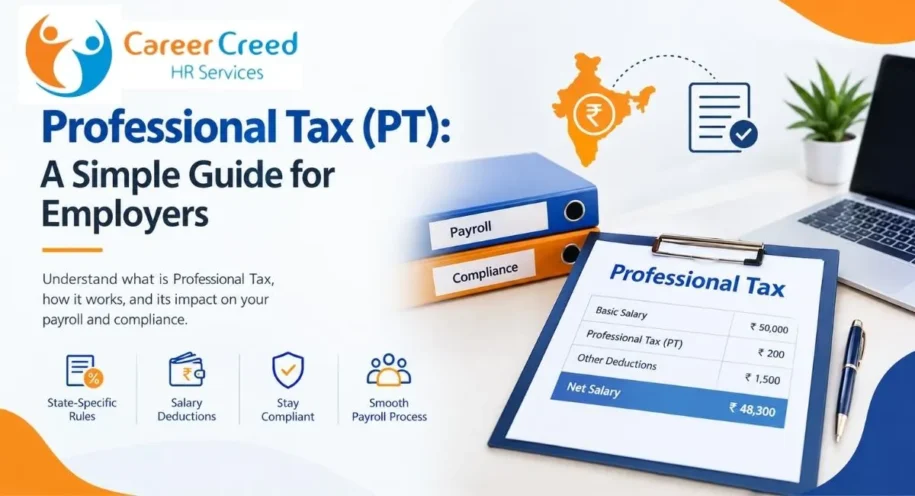
Professional Tax (PT) is a state-level tax charged on income earned through employment, profession, trade, or other eligible activities. For employers, it is important to understand that Professional Tax is not a central tax with one common rate across India. The rules, salary slabs, exemptions, registration process, payment dates, and return requirements can differ from one state to another.
If you manage payroll for a growing business, understanding what is Professional Tax (PT) and how it affects employee salary can help you avoid incorrect deductions and missed compliance requirements.
What Is Professional Tax?
Professional Tax is a tax imposed by certain state governments on individuals earning income from employment, professions, trades, or other specified activities. Although it is called “Professional Tax,” it is not limited only to professionals such as doctors, lawyers, or consultants. Salaried employees may also be covered where the relevant state law applies.
The tax is generally deducted from an employee’s salary by the employer and then deposited with the concerned state government. For example, the West Bengal government states that employers must deduct profession tax from employees according to the applicable salary slab and follow the required registration process.
The Constitution places an overall ceiling of ₹2,500 per person per financial year on professional tax. However, this does not mean that every employee pays ₹2,500. The actual amount depends on the rules and salary slabs of the applicable state.
What About Professional Tax in India?
One important point is that Professional Tax is not applicable in every state or Union Territory. States that levy it can have their own rules and rates.
For example, employers in Odisha are required to deduct Professional Tax from eligible employees and deposit it with the state government. Similarly, West Bengal requires eligible employers to register for deduction of profession tax and submit the required returns.
This means an HR team should not copy a Professional Tax deduction from another company’s payroll setup without checking the employee’s applicable work location and the relevant state rules.
For businesses operating in Delhi NCR, this is particularly important. Delhi currently does not levy Professional Tax, so a Delhi-based salaried employee is generally not subject to a PT salary deduction. However, a company operating across multiple states may have PT responsibilities for employees working in states where the tax is applicable.
How Professional Tax Works
The basic process is fairly simple when the correct state rules are followed.
1. Check whether PT applies
The employer first needs to identify the state or jurisdiction applicable to the employee and check whether Professional Tax is levied there.
2. Check the applicable salary slab
Where PT applies, the employer checks the employee’s salary against the applicable state slab. The amount may vary based on monthly salary and, in some states, other conditions or exemptions.
3. Deduct PT from salary
If the employee is liable, the employer deducts the applicable amount while processing monthly payroll.
For example, if a state requires a particular PT amount for an employee’s salary range, that amount is shown as a deduction in the salary calculation. The employee therefore receives the salary after the applicable deduction.
4. Deposit the amount with the government
The employer collects the amount through payroll and deposits it with the relevant state authority within the prescribed time.
5. Complete returns and records
Some states also require employers to submit periodic Professional Tax returns and maintain records. The exact frequency and procedure depend on the applicable state law. West Bengal, for example, requires registered employers to submit returns electronically.
This is why payroll should not stop at calculating the employee’s net salary. The employer also needs to track deductions, payments, registrations, and returns wherever applicable.
Who Is Responsible for Professional Tax?
For salaried employees, the employer generally acts as the deductor where the applicable state law requires salary-based PT deduction.
The employer may need to:
- Register under the applicable Professional Tax law
- Determine which employees are liable
- Calculate the correct deduction
- Deduct PT from salary
- Deposit the amount with the government
- File required returns
- Maintain payroll and payment records
The exact responsibilities can differ between states. For example, Odisha specifically requires employers to register as Professional Tax deductors and deposit the deducted amount with the state government.
What Are the Benefits of Professional Tax?
Professional Tax is a statutory state-level levy rather than an employee benefit in the usual sense. So, it would be misleading to describe PT itself as a direct benefit that employees receive.
However, following the applicable PT rules provides practical benefits for both employers and employees.
For employers, proper PT handling helps keep payroll records accurate and reduces the risk of missed statutory requirements.
For employees, correct deductions mean that the amount shown on the payslip matches the applicable payroll rules. It also avoids confusion when checking salary records and tax documents.
There can also be an income-tax benefit depending on the tax regime. Professional Tax paid by an employee through salary deduction is generally deductible from salary income under Section 16(iii). However, the Income Tax Department’s current guidance shows that the Section 16(iii) Professional Tax deduction is available under the old tax regime and not under the new tax regime.
Professional Tax vs Income Tax
Professional Tax and Income Tax are different taxes.
| Point | Professional Tax | Income Tax |
| Government level | State-level | Central |
| Applicable everywhere? | No | Generally applicable according to income-tax rules |
| Rate | Depends on state | Based on applicable income-tax rules |
| Salary deduction | Employer may deduct where applicable | Tax may be deducted through TDS |
| Maximum PT | ₹2,500 per person per year | No equivalent PT-style annual ceiling |
| Main law | State-specific legislation | Income-tax laws |
This difference is important because employees sometimes assume that Professional Tax is simply another part of Income Tax. It is not.
Common Mistakes Employers Should Avoid
Small businesses often manage payroll through spreadsheets or manual calculations. This can create problems when employees work in different states.
Some common mistakes include:
Using the same PT rate for every employee: PT rules can vary by state.
Ignoring employee location: The applicable state rules need to be checked rather than relying only on the company’s registered office location.
Deducting PT where it does not apply: A deduction should not be added simply because it appears in another company’s payroll structure.
Missing payment or return deadlines: Deduction is only one part of the process. Employers must also follow the applicable deposit and return requirements.
Not keeping proper records: Payroll records, deductions, payment details, and registrations should be maintained properly for applicable employees.
How PT Works With Payroll Management
Professional Tax is only one part of monthly payroll. A complete payroll process may also involve salary calculations, attendance, leave, deductions, reimbursements, payslips, statutory contributions, and employee records.
This is where proper Payroll management becomes useful. Instead of calculating every deduction manually, businesses can create a consistent payroll process where applicable statutory deductions are identified and recorded correctly.
For businesses with employees in different states, payroll becomes even more important because the applicable rules may not be the same for everyone.
Professional Tax Compliance for Growing Businesses
As a business grows, managing statutory deductions manually can become difficult. A company may have employees joining and leaving, changes in salary, employees working from different locations, and multiple payroll components.
This makes compliance management an important part of HR operations. The employer should regularly check applicable state requirements, maintain records, complete registrations where required, and ensure that deductions and payments are made correctly.
HRMS software can also help businesses maintain employee information and streamline payroll-related processes. However, software should be configured according to the applicable state rules rather than assuming one setup works for every employee.
Leave a Reply