
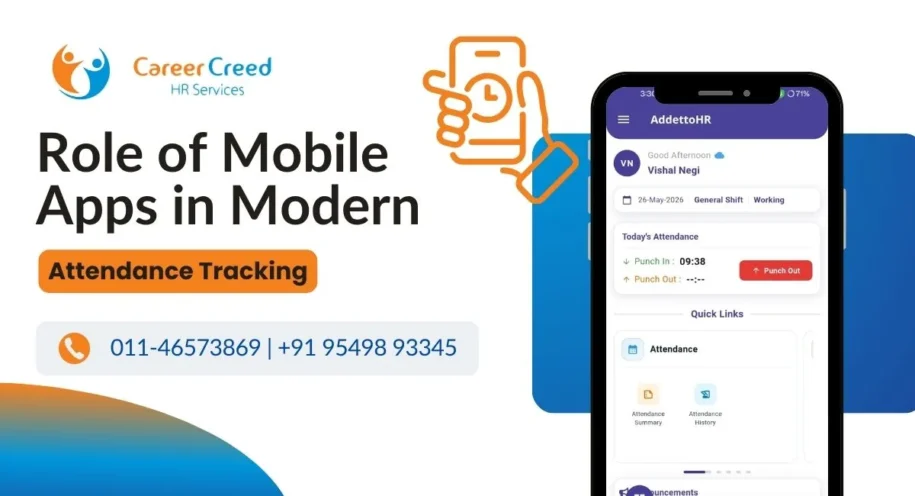
The Role of Mobile Apps in Modern Attendance Tracking has become more important as businesses adopt flexible working arrangements and manage employees across different locations. Attendance is no longer limited to employees punching in at an office entrance. Today, employees may work from offices, client locations, field sites, or remotely, making a mobile-based approach useful for many growing businesses.
For HR teams, mobile attendance can make everyday tracking easier while giving employees a simple way to mark attendance, apply for leave, and check their records. It can also reduce the amount of manual work involved in maintaining attendance data.
Why Mobile Attendance Matters Today
Traditional attendance methods work best when employees follow a fixed schedule and work from one location. A register or office-based machine may be enough for a small team.
But modern workplaces are often more flexible. Sales employees may visit clients, recruiters may travel for interviews, and some teams may work from home. Businesses therefore need attendance processes that can work beyond the office.
A mobile attendance system allows employees to use their smartphones for attendance-related activities. Instead of depending entirely on a physical attendance machine, the business can provide a more flexible digital process.
How Mobile Attendance Apps Work
The exact process depends on the software and the company’s attendance policy.
In a typical setup, employees use the company’s mobile HR application to mark their attendance. The system records the attendance entry and can connect it with the employee’s profile.
Some systems also use location-related features. For example, geo-tagging can record the location associated with an attendance entry, while geo-fencing can restrict attendance marking to an approved geographical area.
Career Creed’s HRMS includes mobile attendance punching along with geo-fencing and geo-tagging features.
This can be particularly useful for businesses that have employees working outside a fixed office environment.
Benefits of Mobile Attendance Tracking
1. Employees Can Mark Attendance From Their Phone
Employees already use their phones for many daily activities. Using a mobile HR application for attendance can therefore be convenient.
Instead of depending on a physical machine, employees can mark attendance through the designated mobile system, subject to company rules.
This is useful for field employees and teams that do not always start their workday from the office.
2. Better Support for Remote and Field Teams
One of the biggest advantages of mobile attendance is flexibility.
Consider a sales employee who is visiting a client in Gurgaon or a recruitment employee travelling for an interview. Asking them to return to the office simply to mark attendance is not practical.
A mobile system can support attendance processes for employees working at different locations, provided the company’s policy allows it.
3. Less Manual Work for HR
When attendance is recorded digitally, HR does not need to collect attendance information from multiple employees and enter it into spreadsheets every day.
This can save time, particularly as the workforce grows.
The HR team can focus more on reviewing exceptions, handling attendance corrections, and managing employee-related matters instead of repeatedly entering routine attendance data.
4. Easier Attendance Monitoring
Mobile attendance data can give HR and managers a clearer view of employee attendance.
Managers may need to know who is available, who is absent, and whether there are pending attendance corrections.
A connected HR system can make this information easier to access without depending on separate spreadsheets or messages.
Career Creed’s HRMS includes manager self-service features such as attendance monitoring, team dashboards, and leave approval workflows.
5. Connection With Leave Management
Attendance and leave should not be managed as completely separate activities.
An employee may mark attendance on one platform and apply for leave through another. This can create unnecessary work for HR.
A mobile HR application can bring these routine activities together. Employees can access attendance information, apply for leave, check leave balances, and raise HR requests from the same platform.
Career Creed’s HRMS provides employee self-service through its mobile app, including attendance, leave applications, leave balance, salary slips, HR documents, and HR requests.
This type of setup can make routine HR communication more organized.
Mobile Attendance and Payroll
Attendance information can also play an important role in monthly payroll preparation.
Before payroll is processed, HR may need to review attendance, leave, absences, and attendance corrections. When information is maintained manually, this process can take considerable time.
A digital system can provide a more organized source of attendance information for review before payroll.
Career Creed’s HR Control Desk includes attendance and leave monitoring, attendance verification, and monthly payroll processing support.
The important point is that mobile attendance should not be viewed only as a way to record “in” and “out” time. It can become part of a wider HR process.
What About Privacy and Misuse?
Mobile attendance also needs proper rules.
Businesses should clearly explain what information is collected, why it is collected, who can access it, and how it will be used. Location-based attendance features should be used according to the company’s policies and applicable requirements.
Employees should also know the process for handling genuine attendance issues, such as a missed punch or technical problem.
Technology works best when employees understand the process and the company applies the rules consistently.
How Mobile Attendance Fits Into HRMS
For a growing business, attendance is only one part of HR management.
Employee records, leave, payroll, documents, recruitment, compliance, performance, and other HR activities also need to be managed. Using separate tools for every function can create disconnected information.
This is where HRMS Software can be useful. An HRMS can connect attendance with other HR activities so that employee information is available through a more centralized system.
Career Creed’s HRMS brings employee information, attendance, leave, payroll, documents, lifecycle management, compliance, and reporting into one platform.
Businesses can therefore use mobile attendance as part of a broader HR management process rather than treating it as a standalone tool.
Choosing the Right Mobile Attendance System
Before selecting a mobile attendance solution, businesses should consider their actual working environment.
Check whether the system supports:
- Mobile attendance punching
- Geo-tagging or geo-fencing, if required
- Employee self-service
- Leave applications and approvals
- Attendance regularization
- Manager access
- Attendance reports
- Payroll-related attendance data
- Secure employee records
- Integration with other HR processes
A company with only office-based employees may have different requirements from a business with salespeople, field staff, or remote teams.
The best system is therefore not necessarily the one with the most features. It is the one that fits the company’s attendance policy and working model.
Mobile Attendance Is Part of Modern HR
The role of mobile apps in attendance tracking is growing because the workplace itself is changing. Employees are no longer always working from one desk or one office location.
A mobile-based attendance process can give employees more flexibility while helping HR maintain better records. When connected with an attendance & leave management Software, it can also bring attendance, leave applications, approvals, and employee self-service into one workflow.
For growing businesses, this can reduce repetitive administrative work and create a more organized way to manage everyday attendance.
The key is to use technology alongside clear attendance policies and simple processes. When both work together, mobile attendance becomes more than just a digital replacement for an attendance register—it becomes a useful part of the company’s overall HR system.
Leave a Reply