
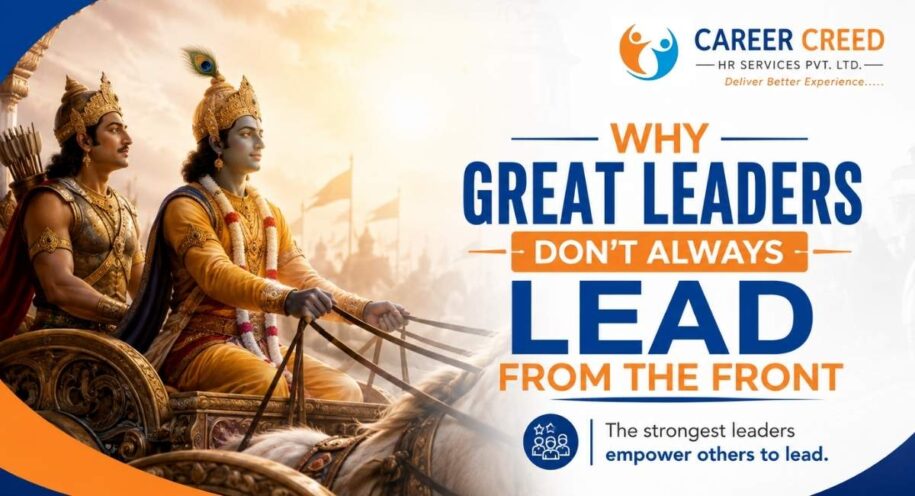
Imagine a battlefield.
Two armies are standing face to face. Thousands of people are waiting for the first move. The pressure is enormous. One decision could change everything.
And yet, the person who would become one of the most important figures in that moment is not holding a weapon.
He is holding the reins.
On the battlefield of Kurukshetra, Lord Krishna chose to become Arjuna’s charioteer. Arjuna was the warrior. Krishna was the guide.
The Bhagavad Gita begins from this moment of uncertainty, when Arjuna is overwhelmed by the people standing before him and struggles with what he should do. Krishna does not fight the battle for him. Instead, he gives him clarity and helps him understand his duty.
That image carries a powerful lesson for today’s business leaders.
Leadership is not always about standing in front.
Sometimes, the strongest leader is the person standing behind the team, helping others move forward.
The Leader Who Did Not Need the Spotlight
In today’s business world, leadership is often associated with visibility.
The founder who makes every decision.
The CEO who speaks in every meeting.
The manager who controls every task.
The leader whose name appears everywhere.
But Krishna’s role with Arjuna tells us something different.
He had the ability to take the centre stage. Yet he accepted the role of a charioteer.
He did not need to be the warrior to influence the battle.
He needed to make sure the warrior could fight with clarity.
That distinction is extremely important for business owners.
A founder who personally handles every employee issue may feel involved.
But involvement is not always leadership.
Sometimes, leadership means creating a system where employees can solve problems without waiting for the founder.
Sometimes, it means giving your HR manager the authority to handle people issues.
Sometimes, it means allowing a young manager to make a decision, even when you could make it faster yourself.
A leader’s success is not measured by how much they do.
It is measured by how much their people can achieve because of their leadership.
Arjuna Had the Skill. He Needed Clarity.
Arjuna was not an inexperienced warrior.
He had skill.
He had experience.
He had courage.
Yet when the moment came, he became emotionally overwhelmed.
He saw people he loved on the opposite side.
His confidence disappeared.
His hands weakened.
His mind became uncertain.
This is where Krishna’s leadership becomes especially meaningful.
Krishna did not simply say, “Stop thinking and fight.”
He engaged with Arjuna’s confusion.
He helped him look beyond the immediate emotion and understand the larger responsibility.
That is what good managers must do too.
An employee may have the skills to perform.
But skills alone do not guarantee good decisions.
People can become confused by pressure.
They can lose confidence after failure.
They can struggle with workplace conflict.
They can become afraid of making the wrong decision.
A manager’s job is not always to provide the answer.
Sometimes, the better job is to help the employee find the answer themselves.
That creates something more valuable than obedience.
It creates confidence.
Great Leaders Create Decision-Makers
Think about a growing company.
The founder starts with five employees.
Every decision comes to the founder.
Which candidate should we hire?
Should we approve this leave?
How should we handle this client?
What should we do about this employee?
Which policy should we create?
At five employees, this may work.
At fifty employees, it becomes exhausting.
At two hundred employees, it becomes dangerous.
The company starts depending on one person.
Employees stop thinking independently.
Managers wait for instructions.
Small problems become big problems because nobody wants to take ownership.
This is where leadership must change.
A leader must gradually move from doing everything to developing people who can do things well.
Krishna did not take Arjuna’s place.
He strengthened Arjuna’s ability to act.
That is a powerful difference.
Leadership Is Also Knowing When to Step Back
There is another side to this lesson.
Stepping back does not mean disappearing.
It means knowing when your presence creates value and when it creates dependency.
A good business leader knows when to intervene.
They also know when not to.
If an employee makes every small decision only after asking the founder, the organization has a leadership problem.
If a manager cannot resolve a team conflict without calling the CEO, the organization has a leadership problem.
If HR needs approval for every routine people decision, the organization has a leadership problem.
The answer is not always another meeting.
Sometimes, the answer is better authority, clarity and trust.
Great leaders build people who can carry responsibility.
Krishna Also Understood That People Are Different
One of the most important lessons from Krishna’s relationship with Arjuna is that leadership was not about treating everyone the same.
Arjuna did not need a lecture about archery.
He needed perspective.
This is equally true inside organizations.
Your best salesperson may not need more targets.
They may need recognition.
Your new manager may not need more pressure.
They may need mentoring.
Your struggling employee may not need another warning.
They may need clarity about expectations.
Your high-performing employee may not need more supervision.
They may need greater responsibility.
The same management style cannot work for everyone.
Good leaders understand people before managing them.
That is where effective HR becomes much more than paperwork, attendance and policies.
HR should help organizations understand people, build capable managers and create an environment where employees know what is expected from them.
Before the Battle, Krishna Sought a Different Path
Krishna’s leadership was not simply about winning a battle.
The Mahabharata tradition also presents him as a diplomat who sought peace before the conflict.
That matters for business leaders.
A strong leader does not create conflict simply to prove authority.
Before terminating an employee, understand the problem.
Before blaming a manager, understand the situation.
Before restructuring a team, understand what is actually failing.
Before assuming an employee is underperforming, ask whether expectations, resources and guidance were clear.
Good leadership does not mean avoiding difficult decisions.
It means making difficult decisions after seeking clarity.
The Most Powerful Position May Be Behind the Team
There is something deeply emotional about the image of Krishna sitting in front of Arjuna’s chariot.
The warrior receives the recognition.
The warrior carries the weapon.
The warrior enters the battle.
But the person holding the reins helps determine where the chariot goes.
That is leadership.
In a company, employees may receive the recognition.
Managers may deliver the results.
Salespeople may close the deals.
Recruiters may hire the talent.
Operations teams may deliver the work.
But behind them should be leaders who create the conditions for those people to succeed.
They provide direction.
They remove obstacles.
They develop people.
They create trust.
They make difficult decisions when necessary.
And most importantly, they know when to step forward and when to step back.
What Should Business Leaders Take Away?
The lesson from Krishna is not that leaders should become invisible.
It is that leadership is not about being the most visible person in the room.
It is about becoming the person who makes the room stronger.
If your business cannot function when you step away for a week, you may have built dependence, not leadership.
If your managers can solve problems without you, you have built capability.
If your employees can make responsible decisions without waiting for permission, you have built trust.
If your team becomes stronger because you are there, you are leading.
And if your team continues to perform well even when you are not there, you have truly succeeded as a leader.
Perhaps that is one of the most timeless lessons we can take from Krishna’s role as Arjuna’s charioteer.
You do not always have to hold the weapon.
Sometimes, your greatest responsibility is to hold the reins.
This Janmashtami, perhaps the question for every business leader is not:
“How can I lead my team better?”
But something deeper:
“Am I building people who can move forward without me?”
Because great leaders don’t always lead from the front.
Sometimes, they sit quietly behind the strongest people in their organization—and help them become stronger.
Leave a Reply